Trust online is approaching a breaking point. As AI-powered impersonation scales toward ubiquity, the way people prove their identity online by uploading photos of plastic IDs, sharing biometrics, and transmitting sensitive ID numbers across the internet is failing to keep pace.
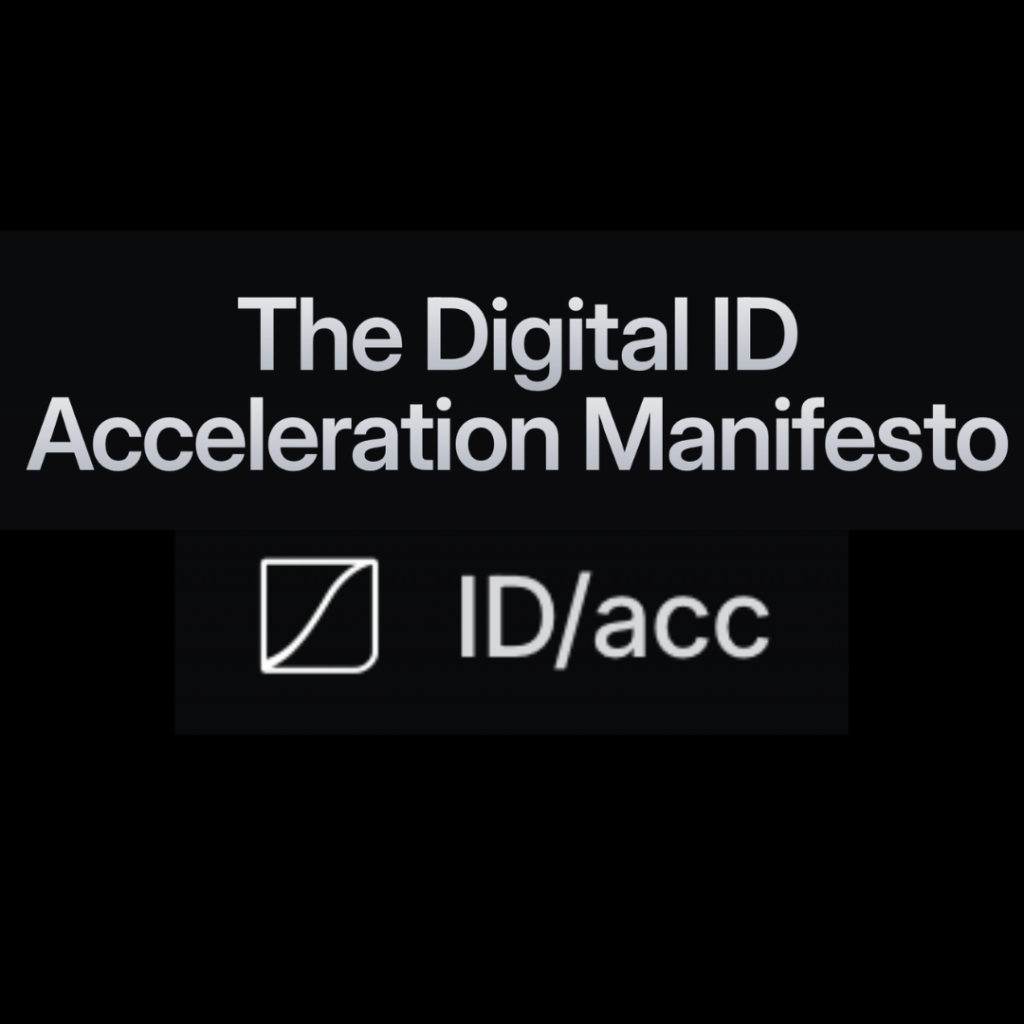
That’s why Trinsic CEO Riley Hughes has launched the Digital ID Acceleration Manifesto (#IDacc): a public call for pragmatic urgency in deploying, improving, and expanding access to digital IDs worldwide.
The manifesto has already been signed by leaders from 15+ organizations, including Cloudflare, OneSpan, AuthID, and others — collectively representing more than 15+ digital IDs across 10+ countries.
Why Now
We are entering what the manifesto calls the “era of default disbelief”. A point where every image, voice, and identity encountered online is assumed to be artificially generated. The tools of industrialized impersonation are accelerating. The tools of scalable proof of authenticity are already here. But rollout is bottlenecked by standards bodies, legislative committees, and platform gatekeepers.
Digital IDs offer a scalable alternative to the status quo. They enable selective disclosure, cryptographic proof of uniqueness, and verification in seconds rather than minutes. Regions with widely adopted digital IDs already exhibit better privacy, safety, and convenience, and less fraud.
The gap is not technology. It’s deployment.
What the Manifesto Calls For
The Digital ID Acceleration Manifesto makes three direct calls to action:
Deploy digital IDs now. Digital IDs are widely used in dozens of countries, issued by governments, banks, and identity providers. Deployment immediately improves upon the status quo.
Improve digital IDs continuously. Acceleration must not stop at deployment. Every existing digital ID must be treated as a starting point, not a destination. Builders, policymakers, and product stakeholders must continuously strengthen privacy, safety, and interoperability.
Expand access and acceptance. Digital ID acceptance is too often gated behind bespoke permissions, closed integrations, and slow approval processes. Wallet providers, issuers, platforms, and regulators must open up. The stakes are too high to onboard millions of businesses at the speed of an approval committee.
Acceleration and Safety Are Not Opposites
The manifesto directly addresses the concern that speed comes at the expense of safety. Digital IDs built without meaningful privacy and security safeguards do increase risks like surveillance, exclusion, and new breach vectors. But the status quo already carries these risks at scale built on plastic ID photos, ID numbers, and biometrics shared broadly across the internet.
Safety is not improved by restricting digital IDs. It is improved by deploying good digital IDs and iterating through real-world use, adversarial testing, and measurement. Maximum safety requires acceleration when the alternative is industrial-scale impersonation enabled by advanced AI.
Join the Movement
The Digital ID Acceleration Manifesto is open for signatures from builders, policymakers, and industry leaders who share the conviction that gradualism is no longer sufficient.
Read and sign the manifesto: idacc.com
For more information about Trinsic’s Identity Acceptance Network, visit trinsic.id.