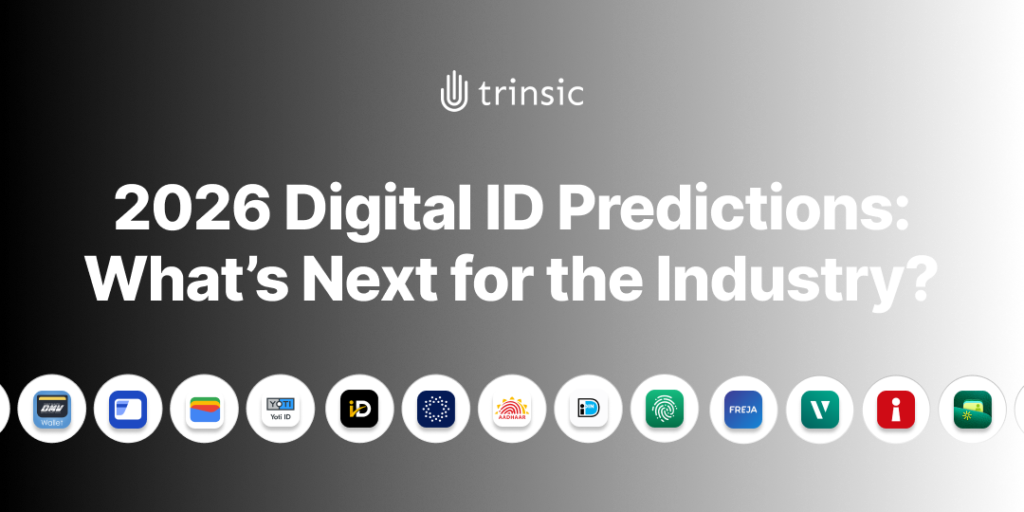
Digital identity crossed an important threshold in 2025. Mobile driver’s licenses (mDLs), reusable IDs, and government-backed wallets moved from pilot programs into early production use. In Trinsic’s annual predictions webinar, Riley Hughes looked ahead to what 2026 is likely to bring and where expectations may collide with reality.
Here are the predictions we believe will define the next year of digital identity.
Digital ID Meets the Agentic AI Era
As AI agents become more capable, trust online is becoming harder to establish and more important than ever. In 2026, we expect digital identity to move beyond an “identity industry” topic and into the broader public conversation as organizations grapple with impersonation, fraud, and automated abuse.
That said, increased attention won’t immediately translate into massive transaction volume. Instead, 2026 will be the year digital ID becomes a recognized pillar of online trust, setting the stage for broader adoption in 2027 and beyond.
Mobile Driver’s Licenses: Progress, Pressure, and Politics
mDL adoption will continue to grow in 2026, but not without friction.
- Remote mDL verification finally takes off.
With ISO 18013-7 now finalized, 2026 is expected to be the breakout year for online mDL use, especially in the U.S. and Australia. This standard removes the need for specialized hardware, making mDLs practical for everyday online verification. - U.S. mDLs become politicized.
As adoption increases, mDLs are likely to be pulled into U.S. election-year debates around voter ID. While increased visibility could raise awareness, politicization also risks slowing adoption if businesses perceive digital ID support as politically sensitive. - Fragmentation accelerates at the state level.
Utah’s “state-endorsed digital identity” approach may not remain unique. We predict at least one additional U.S. state will pursue an alternative digital ID model in 2026, potentially increasing fragmentation rather than convergence.
Apple, Google, and the Limits of OEM Wallets
OEM wallets will continue to play a major role, but they won’t define the entire ecosystem.
- Apple Wallet expands ID support into Canada.
One of our bolder predictions: Apple Wallet begins supporting ID credentials in at least one Canadian jurisdiction in 2026. Whether or not this specific outcome materializes, the broader takeaway is clear – OEM wallets will not be universally available across all geographies anytime soon. - Google Wallet becomes the world’s most adopted ID wallet.
Driven by Android’s global footprint and expanding credential support, Google Wallet is likely to become the largest ID wallet by adoption worldwide by the end of 2026. - mDL adoption remains split across wallet types.
Even with growth, we expect mDL adoption to remain roughly 50% in OEM wallets (Apple, Google, Samsung) and 50% in jurisdiction-specific apps. Businesses that only integrate OEM wallets will continue to miss significant coverage.
Europe and the Reality of EUDI
Europe will remain the center of gravity for government digital identity, but timelines will slip.
- Only half of EU member states meet the 2026 EUDI deadline.
Despite strong momentum, we predict that only around 50% of EU countries will have fully compliant EUDI wallets in production by the end of 2026. Governance questions – who can verify, how relying parties register, reciprocity between countries, and viable business models – will slow progress. - Five countries still reach massive scale.
At the same time, we expect five EU countries to surpass 10 million EUDI wallet users (or ~80% adoption in smaller nations). Most of this growth will come from existing national or private digital ID systems upgrading to EUDI-aligned standards, not from entirely new wallets starting from scratch. - Waiting for “perfect EUDI” will be a mistake.
Organizations that delay adoption until EUDI is fully settled risk falling behind competitors who integrate today’s leading digital IDs and transition smoothly as standards evolve.
The UK Favors Private Reusable IDs
In the UK, we predict private reusable ID solutions will remain the dominant form of digital identity in 2026. As government rhetoric around compulsory digital ID cools, certified private wallets will continue to power most private-sector use cases.
For businesses operating in the UK, this means digital ID strategies must include private reusable IDs, not just government wallets.
Orchestration Wins the Enterprise Market
By 2026, nearly every identity provider will support digital IDs. But not all will win the largest, most complex deals.
We predict that platforms with strong orchestration capabilities – combining digital IDs with biometrics, document fallback, address verification, video IDV, and behavioral risk signals – will dominate enterprise adoption. Digital IDs improve the experience, but they won’t cover every scenario on their own.
One Billion New People Become Eligible for Digital ID
A major shift is coming from emerging markets. As countries with large biometric registries move toward user-controlled wallet models, we expect approximately one billion additional people to become eligible for wallet-based digital IDs.
This expansion will dramatically increase the global addressable market for digital identity and accelerate leapfrogging in regions that bypass legacy verification models altogether.
A Controversial Prediction on Privacy
Our most debated prediction: in 2026, privacy maximalism may have a net negative impact on privacy.
Pushing for perfect, risk-free digital ID solutions can slow adoption, leaving businesses and regulators reliant on document uploads, selfies, and long-term data retention. While privacy advocacy is critical for improving systems long term, the near-term tradeoff may be slower adoption of tools that are already more privacy-preserving than today’s status quo.
The Road Ahead
2026 will not be the year digital identity “solves itself.” Instead, it will be a year of real-world tension, between AI and trust, standards and fragmentation, privacy ideals and operational reality.
For businesses, the lesson is clear: don’t wait for a single wallet, standard, or geography to win. The organizations that succeed will be those that build flexible, forward-looking digital ID strategies now, while preparing for rapid scale in the years ahead.
To watch the full predictions webinar, check out the recording here.